


Troy University Arboretum New Wayfinding Strategy
⭐️ Winner of the 2026 Judge's Choice & Silver ADDY Awards — aaf Montgomery, AL, USA
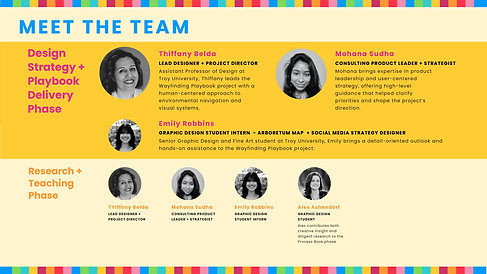
Serving as lead designer and project director on a project involving two student interns and an industry expert, I developed a research-informed wayfinding strategy that supports intuitive navigation, accessibility, and long-term stewardship. The project upgrades a pre-existing signage system that lacked cohesion, visibility, and clarity, and functioned simultaneously as a public service initiative, a teaching platform, and a cross-industry collaboration.
The resulting Arboretum New Wayfinding Strategy balances clarity with flexibility, enabling incremental implementation across unknown budgets, fabrication methods, and evolving site conditions. It establishes a cohesive framework that aligns visual language, information hierarchy, and governance rules into a practical system designed for long-term maintenance and growth.
Wayfinding Strategy, Experiential Design, User Experience, Visual Systems, Information Architecture, Iconography, Color Systems, Typography, Design Systems, Governance Frameworks, Accessibility Design, Research, Field Observation, Stakeholder Collaboration, Adobe Illustrator, InDesign, Figma


The Arboretum New Wayfinding Strategy is grounded in data, clarity, and hierarchy.
Rather than relying on branding alone, the system prioritizes legibility at distance, environmental contrast, and consistent visual logic across vehicular and pedestrian contexts. Modular iconography, color-coded trails, and typography work together to reduce cognitive load while reinforcing place identity.
Accessibility is treated as a system requirement that informed decisions around contrast, placement, scale, and repetition throughout the environment.


The new wayfinding strategy defines a clear family of sign types that guide visitors through arrival, orientation, decision-making, and navigation across the Arboretum.
A unified visual language connects trail icons, directional signage, maps, and interpretive elements. Color supports recognition and hierarchy, while icons and text provide redundancy for varied lighting conditions, distances, and user abilities.
All sign schematics are conceptual and illustrative, allowing final execution to respond to budget, materials, and fabrication resources without compromising system integrity.


To ensure long-term consistency, a comprehensive Wayfinding Playbook was developed.
The Playbook defines system logic, sign families, color and typography rules, accessibility commitments, fabrication flexibility, maintenance protocols, and phased implementation strategies. It serves as a shared reference for Arboretum staff, volunteers, fabricators, and future stakeholders, enabling the system to evolve while remaining coherent. An accessible Wayfinding Playbook supports future grant applications, phased rollouts, and ongoing stewardship.
.png)

As lead designer and project director, I served as the primary client liaison and oversaw the wayfinding strategy, visual system design, and Playbook development.
The Arboretum New Wayfinding Strategy Project required close collaboration with Arboretum staff and cross-industry consultation with a product strategy professional to ensure the system could scale beyond institutional constraints. It also functioned as a mentorship platform, guiding student interns through supervised design contributions while embedding real-world systems thinking into academic practice.
.png)



Award Winning Design
This Project was recognized at the 2026 American Advertising Federation Awards Gala, taking home the Judge's Choice ADDY & Silver Awards.
Highlights of A Robust Process
The 273-page Process Book captures the research, data insights, and design exploration behind the Arboretum New Wayfinding Strategy, documenting site analysis, stakeholder input, and detailed recommendations. It serves as a strategic record that supports informed decision-making, future planning, and long-term stewardship.
Follow this link to see the complete Wayfinding Process Book.


